
The first big flag football fans may be watching high school girls
Before LA28 turns flag football into an Olympic TV product, girls programs are already teaching new fans how to watch the sport.
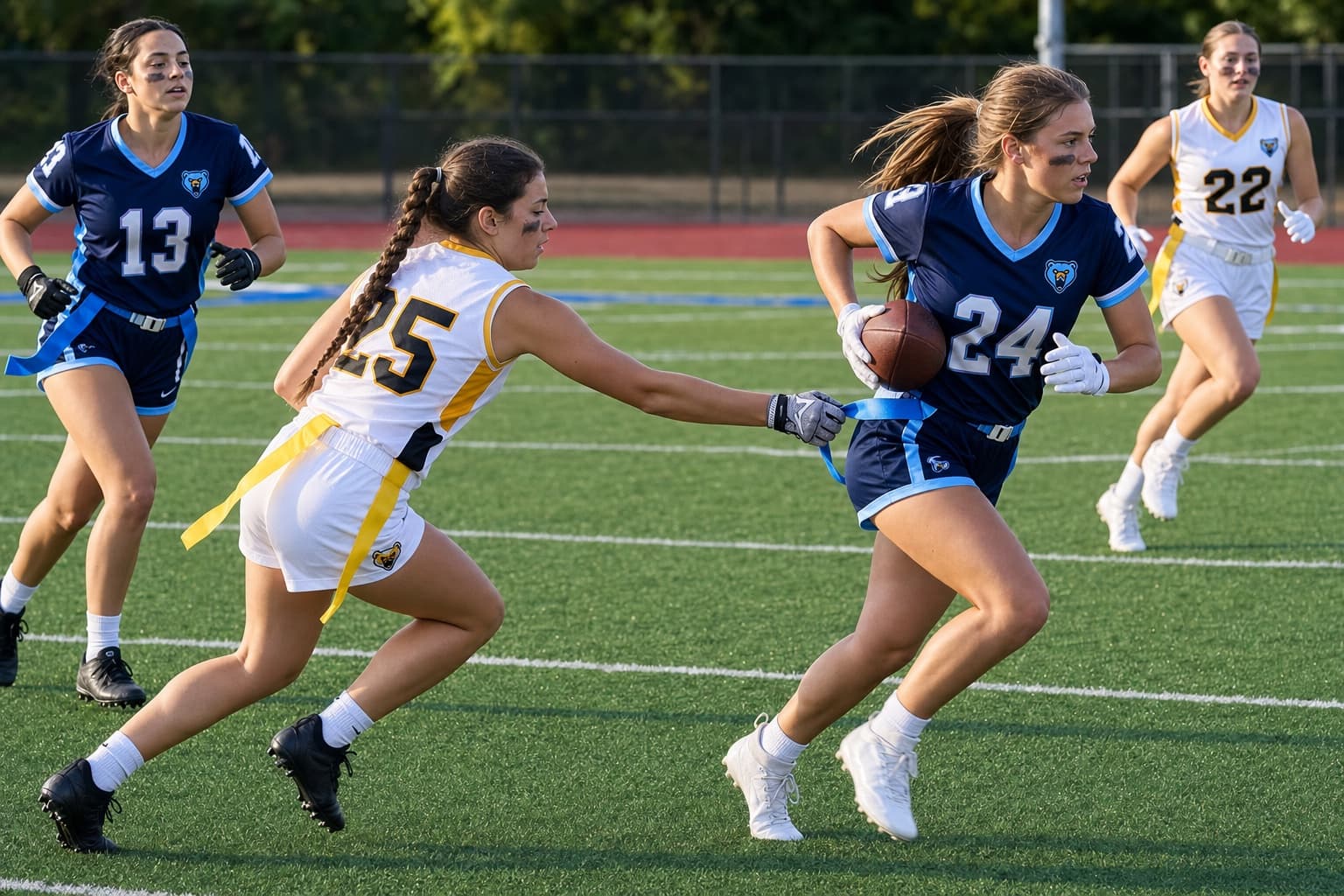
Flag football is often discussed through the NFL and the Olympics, but the clearest fan story this week is the fast-growing girls pipeline from club tournaments to high school recognition, college programs, and LA28.
The fan story is starting below the spotlight
Flag football's Olympic story is usually told from the top down: LA28, the NFL, Team USA, possible NFL stars, TV deals, a new pro league.
But this week, the more interesting version of the story is happening lower on the ladder.
In Southern California, more than 300 athletes played in the Los Angeles Rams' inaugural Girls Flag Community Club Championships at Dignity Health Sports Park, with 25 teams across seven club organizations competing in age divisions from 10U through 18U.[1] A day earlier in the news cycle, NBC Sports and Overtime announced plans to name an inaugural Girls Flag Football All-American Team, giving top high school players a national recognition platform tied to the Navy All-American Bowl and OT7 Championship broadcasts.[2]
That is what a sport looks like when it starts building fans before it builds celebrities.
For casual viewers, girls flag football may become the easiest entry point into the game. The players are young enough that the story still feels open. The sport is new enough that fans can learn it without needing decades of background. And the stakes are rising quickly: college programs, national team pathways, Olympic qualification, pro investment, and media coverage are arriving almost at the same time.
The result is a rare sports moment. You do not have to catch up to flag football. You can arrive now.
The pipeline is becoming visible
The most important change is not just that more girls are playing. It is that the pathway is becoming legible.
At the youth level, the 2026 NFL FLAG Championships are scheduled for July 23-26 at Grand Park Sports Campus in Westfield, Indiana, with more than 350 girls and boys teams expected from around the world.[3] ESPN coverage is again part of the event plan, with games scheduled across ESPN platforms, ABC, NFL+, Disney channels, and international markets.[3]
At the high school level, NBC Sports and Overtime are now creating a national All-American recognition layer for girls flag football.[2] That matters because honors, rankings, broadcasts, and social clips are how casual fans learn names. They are also how a sport tells young athletes, There is a next level here.
At the college level, flag football is moving toward NCAA championship status. On May 19, 2026, an NCAA committee formally recommended adding a National Collegiate Flag Football Championship; if all three NCAA divisions approve legislation in January 2027, the first championship could be held in spring 2028.[4] The NCAA also said more than 100 schools are planning to compete during the next academic year.[4]
That timing is almost too neat: high school growth now, college structure next, Olympic debut in Los Angeles in 2028.
For fans, this creates a clean viewing arc. The player you see in a local club championship today might be a college athlete in two years, a national team trialist after that, and eventually part of the Olympic conversation. Not every athlete will climb that ladder, of course. But for the first time, the ladder is easy to see.
Why this is different from tackle football
Flag football is not just smaller football without pads. It asks fans to watch different things.
There are no linemen in the Olympic-style 5-on-5 game. Space matters more than collisions. A short throw can be as exciting as a deep ball if it beats leverage. A defender who takes the correct angle and pulls a flag cleanly can swing a possession as dramatically as a tackle-for-loss would in the NFL.
That makes the sport unusually friendly to new viewers. You can understand the basic goal quickly: move the ball, create space, pull flags, protect the end zone. But the more you watch, the more you notice the deeper game: route timing, quarterback patience, disguise, red-zone spacing, and whether a defense can force throws into crowded windows.
This is where girls flag football could become especially important for the fan base. If the sport's growth is driven only by NFL names, viewers may judge it by tackle football expectations. If the growth is driven by players who specialize in flag, the audience learns the sport on its own terms.
The U.S. already has elite specialists. USA Football says it selects and leads the U.S. flag national teams, and its pathway moves athletes through talent evaluation, trials, training camps, and final 12-player teams for international competition.[5] The same page lists the U.S. women as winners of three straight IFAF Flag World Championships and the U.S. men as winners of six of the past seven.[5]
That dominance creates a useful tension. The U.S. is the favorite, but the world is not waiting politely. The Olympic tournament will be tiny: only six men's teams and six women's teams.[6] A small Olympic field means every qualification spot will be precious.
The fan story is not America invented it, America wins. It is America has the deepest pipeline, but the Olympic version will leave very little room for mistakes.
The media is arriving before the Olympics
Another reason this moment feels different: media companies are not waiting until 2028.
The NFL FLAG Championships are already built for broadcast distribution.[3] NBC Sports and Overtime are attaching national recognition to girls flag football before the sport has an NCAA championship or Olympic debut.[2] And in March, the NFL announced a partnership with TMRW Sports to develop and operate a professional flag football league for women and men, backed by NFL clubs, investors, and current and former NFL players.[7]
That does not guarantee a successful pro product. New leagues are hard. Fan habits are harder. But it does show that major sports organizations are treating flag football as more than a participation program.
For fans, the next two years may feel like watching scaffolding go up around a sport in real time. Youth tournaments get televised. High school athletes get national recognition. Colleges add programs. National teams prepare for LA28. A pro league tries to find its shape.
Some of this will work. Some of it will probably look awkward before it looks polished. That is part of the appeal.
What to watch next
If you are new to flag football, do not start by asking whether NFL quarterbacks will join the Olympic team. That question is fun, but it can swallow the whole sport.
Start with the girls and women already building the game.
Watch how high school players create space without contact. Watch which athletes can defend in the open field. Watch how quickly quarterbacks release the ball. Watch whether media coverage starts naming players consistently enough for fans to follow them from one stage to the next.
The next major fan checkpoint is the NFL FLAG Championships in Indiana in late July.[3] After that, the international qualification race will sharpen the LA28 picture.[6]
The sport's Olympic debut is still two years away. But the fan base is being built now, at club tournaments, in high school recognition programs, on college campuses, and through the first serious attempts to turn flag football into a watchable product.
That is why this week's small-looking stories matter.
The future of flag football may not begin with an NFL star stepping into the Olympic spotlight. It may begin with a high school girl whose name fans learn before the rest of the sports world catches up.